Wednesday, 4 January 2023

Art Myth #3: What I do isn't really 'art'

I thought that today I'd ask a really important question. 

People sometimes say to me that the work they produce 'isn't really art'.

But what actually is art? 

It's a toughie isn't it? 


‘Art’ is a curiously difficult beast to pin down. 

For a start, it depends on your perspective. Here, in the West, the Encyclopaedia Britannica calls art:

'The use of skill and imagination in the creation of aesthetic objects, environments, or experiences that can be shared with others’. 

What’s interesting about that definition is that applies as equally to artwork produced by primary school children as it does to works by Rousseau or Kahlo or Klimt. Children make aesthetic judgements, just as adults do. Most people make art for the sheer joy of doing so. The only difference between a professional artist and anyone else is that they get paid for their work. But they are all artists and they all create equally valid art. 


We don’t know for sure why our ancestors painted images of wild beasts on cave walls, but it's doubtful that they thought they were making art. They were simply expressing themselves. Or perhaps there was some ritual or magical element to it (many were painted inside pitch black caves where they were hardly putting their work on show). Or perhaps it was an early form of visual record keeping that existed before writing? After all, many ancient writing systems - such as Egyptian hieroglyphs, Cuneiform, Ogham and Chinese Kanji - use characters that are more like drawings than what we would recognise as letters. The point is that it was art being created not for a gallery or to make money. It was just raw human creativity in action.

And, when we look at the beautiful frescoes and ceilings of churches and cathedrals, we have to ask ourselves – were these paintings done as 'art'? Certainly, in the ancient world, artists were viewed in the same way as plumbers and carpenters - they were simply artisan technicians. Things had changed by the time of the Renaissance but, even then, the artwork was rarely an extension of the artist's personality. It was more about reflecting the desires of the patron and, in the case of large religious pieces, to cement the power of the church. So, even though these works were accomplished and technically brilliant, in some ways they are less purely 'art' than the cave paintings.

The online Farlex Free Dictionary says that art is, ‘Human effort to imitate, supplement, alter, or counteract the work of nature’. That's an interesting one. Rocks that have been sculpted into curious shapes by wind, rain, sea and volcanic upheaval can be beautiful but, without conscious effort to create them, they are just happy accidents. They are not art. Flowers and butterflies and decorously coloured coral reef fish are lovely things but their colours and shapes have evolved for a purpose - the fact that we find them beautiful is neither here nor there. Nature is not an artist although, of course, artists can incorporate them into an artwork or be inspired by them. 

And, on the subject of nature, some animals may be able to splash paint onto a canvas but they are not creating art. There is no conscious aesthetic decision-making going on. They're just having fun - the same fun they'd have if you replaced the paints with water. Be very wary of videos showing elephants that supposedly can paint - it's been proven time and again that they are reacting to silent commands from their handlers. It's all done for the tourists.


The Oxford English Dictionary says that art is ‘the products of human creativity’ and the Miriam-Webster Dictionary describes it as ‘the conscious use of skill and creative imagination especially in the production of aesthetic objects’. Skill, creativity and imagination, eh?  You can’t tell me that you haven’t ever employed all of these things to make something that looks nice. Maybe you’ve made a birthday cake and decorated it. Or you’ve arranged flowers at a loved one’s wedding. Or designed a garden. Whatever you’ve done, you’ve used some form of artistic expression. 

So you made art. You're an artist.

Art is not the sole preserve of people who get exhibited in galleries. Every human is capable of artistic expression. 

I’d argue that it’s impossible to sum up what art is in a single handy definition. Some thinkers and academics have suggested that we don’t even try. 

Leo Tolstoy insisted that what makes something art is how it is perceived by the person experiencing it; in other words, beauty is in the eye of the beholder. And it’s true, as we discussed yesterday, that there will always be art you like and art that you don’t. But that's a good thing because if all agreed on what 'good' art is, our galleries would be as boringly homogenous. 

Famously, in the mid-1990s, two dissident Russian artists called Vitaly Komar and Alex Melamid set out to discover what a true 'people's art' would look like. Using a professional marketing firm, a nationwide survey was conducted to determine what Americans wanted in a painting. As Komar said at the time, 'It is a collaboration with a new dictator - Majority.' The survey revealed that 44% of Americans said they preferred the colour blue, 49% of them liked outdoor scenes – particularly if they included lakes, rivers, and oceans - while 41% expressed a preference for large paintings and 56% said they would rather have historical figures in their paintings than contemporary ones. Animals were almost universally popular too. And ‘realistic’ art was more popular than abstract art. 

Blue. Outdoors. A lake. Historical figures. Animals. 

The results were then turned into a painting called America's Most Wanted (see below). Logically, it should be  the perfect picture as it hits the brief exactly. But how many people would want to hang it on their walls?

It does nothing for me. I find it pretty uninspiring and confusing.   
Komar and Melamid proved a point here - you can't create art by public vote or by committee. They also asked people what they didn't like in art and produced this piece as the result:


I'm not keen on that one either ... but I prefer it to the first. 

You may disagree. Or you may like, or dislike, both. But that's fine.

Art is all about individual expression and individual taste. One person's masterpiece is another person's trash and no single piece of art is ever going to be universally loved and valued.

So, I come back to my starter question - What is art?

The Institutional Theory of Art states that art becomes art when it’s labelled as such. For example, no one thought that a urinal with ‘R Mutt 1917’ written on it could be art until Marcel Duchamp placed it within the context of art. But even then, I imagine many people still look at it and think ‘But isn’t that just a urinal?’ Well, yes it is. But Duchamp was using it in an artistic way. Whether the viewer likes it or not is neither here nor there – as stated in the video at the top of this blog, something becomes art when an artist 'puts it out there to be appreciated'. Or not.


Functionalist Theory suggests that art is only art if it performs an artistic function, which is an interesting idea. It would mean that a Henry Moore sculpture used as a doorstop would therefore no longer be art as it's only being used for a utilitarian purpose. 

Yet another theory – the Proceduralist Theory - suggests that art is defined by the process the artist went through to create it, regardless of public reception or the use to which it is put afterwards. That, of course, is in direct opposition to the Functionalist Theory. However, many pieces of Land Art fit into this category as they are ephemeral and will soon be destroyed by the weather or the environment they are in. But lack of permanency - even if the finished piece only survives long enough to be photographed - doesn't mean it isn't art.
 

Art by Nils-Udo (left) and Andy Goldsworthy (right).

And there are many, many more definitions and theories, some of which - as you can see - contradict each other. So it's hard to know who is right (if, indeed, anyone is).

If we must insist on some kind of a definition, we can at least pull together several common themes:  

1. Art is something created by a human. It's not made by Nature or natural processes. There must be a conscious, guiding hand behind it. It's possible that some very smart animals - such as our closest relatives the apes - may have a rudimentary aesthetic sense. But, if so, it's very underdeveloped. Animals rarely make things that have no obvious purpose or use. Art has no function other than to be art.

2. Art is an extension or expression of the artist’s personality. Give three different artists the same commission to create an artwork - even if the brief is quite tight - and you’ll get three different pieces. Their interpretations will differ. Their choice of materials will differ. And the sum total of their life experiences will influence their decision making.

3. Art is Aesthetic. This is a word that comes to us from ancient Greek and it means ‘to heighten or stimulate feelings’ (the opposite, incidentally, is ‘anaesthetic’ which means to shut them down or numb them). Art doesn't have to be beautiful. But it should be something that provokes a reaction, even if it is only a sense of satisfaction or pleasure in the person creating it. Art can make people angry. It can make people cry. It can make them wonder. Art is all about feelings. 

Interestingly, despite all of my reading and having asked lots of people what art is, no one – not one single person so far – has ever suggested to me that art is the sole preserve of professionals. Nor has anyone ever claimed that art isn’t art until it has a monetary value or critical acclaim. And no one has ever said to me that art is limited to certain kinds of expression or specific subjects. 

Literally, anything goes. 

So, there we go. Art is wood and stone, wool and felt, paint and canvas, icing and marzipan, photo and video, pastels and pencils, even frozen bodily fluids or dead sharks in tanks of formaldehyde. Art is formal and informal, permanent and transient, figurative and abstract. Some art is photographically precise while other pieces are seemingly unfathomable. It’s found objects assembled in new ways. It’s a beautiful ballet, a sculpture of a horse, a decorous wedding cake, an exciting new piece of architecture, a hand-thrown pottery teapot, or a photo of your grandmother gamboling in a field of poppies. 

Art is whatever you decide it is. And an artist is someone who creates art because they are driven to do so - it's as simple as that. 

As Dale Carnegie once said, ‘The essence of all art is to have pleasure in giving pleasure.’ 

I can't argue with that.


Tuesday, 3 January 2023

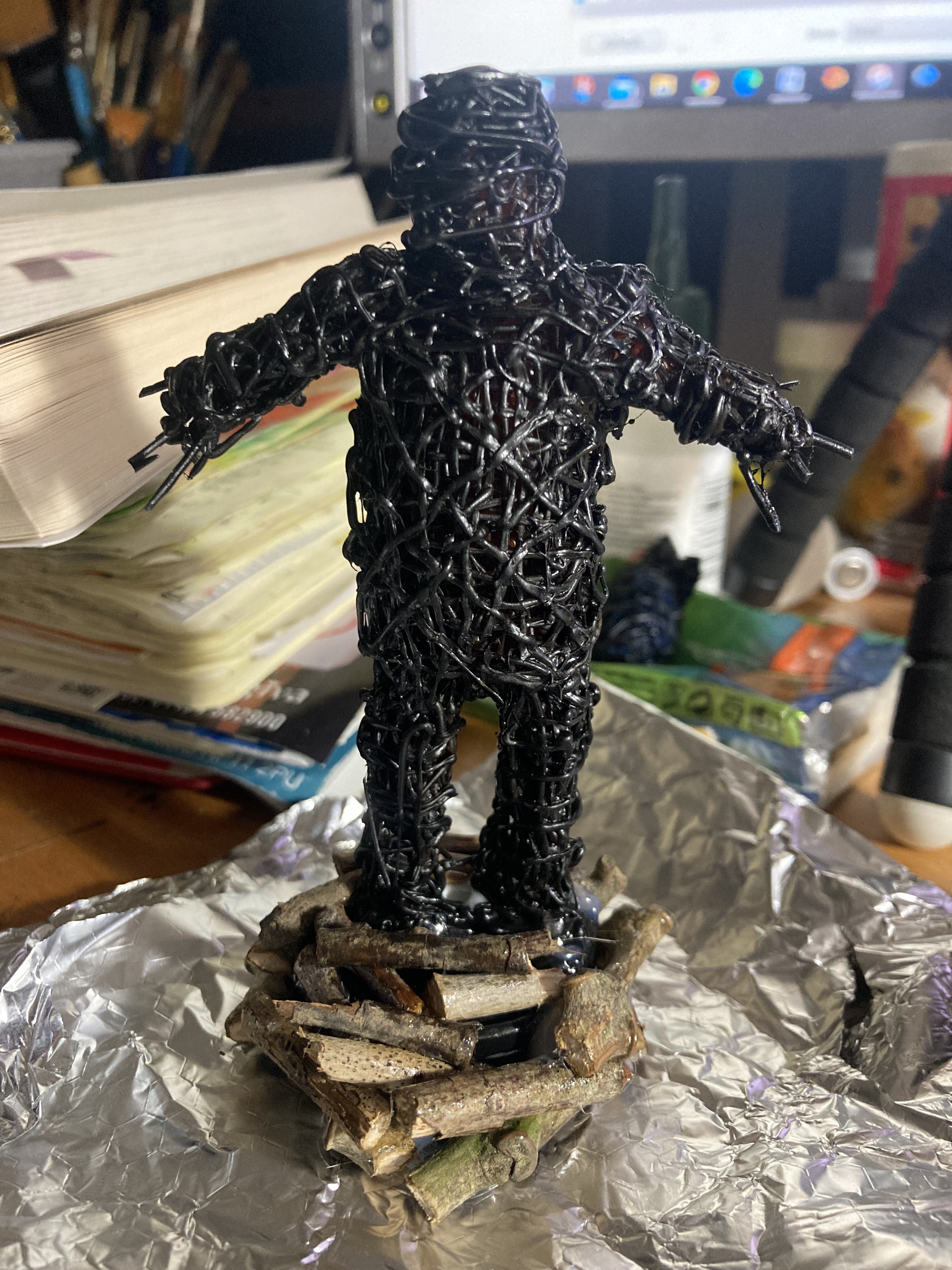
Happy Birthday Wicker Man

One of my daughters bought me a 3D pen for Fathers' Day last year. 

I can't say that I've got the hang of it yet but I did make myself a Wicker Man (as in the film) using the pen, some twigs and a bit of spray paint.
It's hard to believe that The Wicker Man is 50 years old this year. It's a brilliant film, often touted as one of the best ever made in the UK. The late Cristopher Lee - who was one of the world's most prolific actors with nigh on 300 film roles under his belt - reckoned playing Lord Summerisle was his best performance.


But was the Wicker Man based on any kind of true historical practice? Probably not. Although there is some evidence that the Celts engaged in blood sacrifices, there are few mentions of a Wicker Man and they all stem from Julius Caesar who wrote in his Commentary on the Gallic War that a large wickerwork figure with limbs was filled with living men and set on fire. He says that criminals were the preferred victims, but that innocent people might also be burned if there were no criminals. 


Writing slightly later, Strabo wrote in his Geographica that men and animals were burned in a large figure of wood and straw, although he does not make clear whether the victims were burned alive. He added that the ashes were believed to help the crops grow. 

Some modern historians and archaeologists stress that the ancient Greco-Roman accounts should be viewed with caution, as Greeks and Romans 'had good reason to dislike a long-term enemy' and it may have benefited them to 'transmit any bizarre and negative information' about the Celts. Their desire to depict Celtic peoples as barbarians may have led to exaggeration or even fabrications.

Whatever the truth, happy birthday Wicker Man.


Art Myth #2: My art isn't as good as other art

When I taught art, I heard lots of people say things like, 'My stuff is terrible. All I can draw is stick people.'

To them I replied, 'That worked out pretty well for L S Lowry.'

And that's the subject of today's essay: 

Is there such a thing as good or bad art?

I'd argue that notions of good or bad are in the eye of the beholder. And they are more likely to relate to  personal taste and preference than to any measure of quality. 

Let's for a moment, compare art with another great sensory pleasure - eating. How are the products of professional chefs judged?  

If you go into a McDonalds’ pretty much anywhere in the UK you'll find that the Big Macs look and taste pretty much the same. The company has set a standard and aims to ensure that every meal meets it. Their success is judged on homogeneity and numbers of units sold. They are producing food to match the tastes and desires of the customer and they sell millions of Big Macs. 

So they must be good, right?

But now let's visit Heston Blumenthal's multi-award winning Fat Duck restaurant. His iconic Snail Porridge dish doesn't sell in the millions. It's also very expensive. So we can't judge it by sales figures or value for money. Instead, we reward it for its originality and creativity. Heston has a whole bunch of Michelin Stars. 

So his food must be good, right?

Here we have two very different products being valued as 'good' or 'bad' food by different methods. But those value judgments break down if you don't like the taste of either.

To a McDonald's lover the Big Mac is good food. It's safe, predictable, tasty and exactly what they like to eat. To the gourmand who seeks out new flavours and food experiences, the edgy delights of Snail Porridge will appeal more. But neither food lover is right or wrong. They just have different palates (and budgets). As I said above, it's all in the eye (or the tastebuds) of the beholder. 

Art is the same. Some people will prefer traditional landscapes, portraits or still lifes. Others will like experimental abstract art. But we can't say that one type of art is good and the other bad. As Carl Rogers once said, ‘The very essence of the creative is its novelty, and hence we have no standard by which to judge it.’ 

Now, it must be said that if you are making art to a tight brief - such as a graphic novel where it's expected that the characters are all recognisable - then any deviation from that could be seen as 'bad art'. Similarly, if the perspective is warped or the anatomy is all wrong, you might be tempted to say that it's 'bad'. But then again, many of the comic artists we now regard as groundbreaking did exactly that. They broke the rules. They were asked for a Big Mac and they produced Snail Porridge.

The great joy of visual art is that every rule is there to be broken and your choice of medium is limited only by your imagination. All you need is the passion and drive to create and the belief that what you produce has value. It can be wrapping a river bridge in gold cloth. It can be spraying on a wall with an aerosol paint can and cut-out templates. It can be a photograph of a crucifix in a tank of urine. Art doesn’t stand up to comparison between artists and styles. 

Could you assign grades to different works of art? How would you score them? And against what benchmark would you compare them? Would Lowry's stick men score equally as well as Barbara Hepworth’s pierced stones or Jackson Pollock’s drizzled canvasses? They’re all so different. What criteria do you use?

How do you compare an apple to an orange? Or a banana to a pear? How do you compare unlike with unlike? 

You can’t, of course. We can't say that any one fruit is good or bad. We can't say which is best. All we can say is which we’d prefer. And we might all choose differently … which means that, depending on who you ask, all of them could potentially be the ‘best’. Or, indeed, the worst. 

When I taught art with youth groups I ran an exercise where I sent them off into the National Gallery and told them to come back with a list each of the best three works of art. They all came back with different lists. 

But what about professional art critics, I hear you ask? Can't they guide us?

Not really. Because they can't agree on good or bad either.


Image: Karen Bryan (Creative Commons)

In 1998, conceptual artist Tracey Emin famously suffered a three day emotional and physical breakdown in which she spent most of her time in her bedroom. She then transported her bed - unwashed and unmade – and its immediate environs to Tate Britain and put it on display. My Bed was also entered for the prestigious Turner Prize and Emin sold the piece for a reported £150,000 to the Saatchi Gallery. 

This is how the gallery catalogues the piece: ‘A consummate storyteller, Tracey Emin engages the viewer with her candid exploration of universal emotions. Well-known for her confessional art, Emin reveals intimate details from her life to engage the viewer with her expressions of universal emotions. Her ability to integrate her work and personal life enables her to establish an intimacy with the viewer. Tracey shows us her own bed, in all its embarrassing glory. Empty booze bottles, fag butts, stained sheets, worn panties: the bloody aftermath of a nervous breakdown. By presenting her bed as art, Tracey Emin shares her most personal space, revealing she’s as insecure and imperfect as the rest of the world.’ 

Are you convinced? Maybe you are, maybe you aren’t. But that’s the issue under discussion here -  opinion. Whether you love the piece or not – and few living artists divide popular opinion more than Tracey Emin - there’s no doubt that it is considered fine art by some experts. 

But not all of them. 

The late Brian Sewell - one of the UK's best known art critics - called the piece ‘self-sentimental memorabilia’ and said of Emin herself: ‘The sane man must ask whether he should give any of this pretentious stuff the time of day in aesthetic terms when it seems that this self-regarding exhibitionist is ignorant, inarticulate, talentless, loutish and now very rich.’  Michael Glover called her work ‘unadulterated, self-indulgent crap’ and, most savage of all, Philip Hensher wrote: ‘Is it possible to be a good conceptual artist and also very stupid? There's no hope for Tracey Emin. She's just no good.’ 

But balance that against popular critic and documentary maker Waldemar Januszczak who wrote of Emin’s work: ‘It's a voice that has never been heard in art before because the Professor Higginses who run the art world have never allowed it into art before.’ Or Marcus Field who said that, ‘Some have questioned whether such apparent unmediated outpourings can constitute art. And yet there is so clearly artistry involved. Apart from the obvious handiwork, there's the crucial defining feature of an artwork: that it should not only represent life, but reveal something about it, too. Her work may not do this for many of the men or metropolitan elite who despise it so much, but I suspect that it articulates feelings for others in a way unique in fine art.’ 

See what I mean? Even the experts can’t agree with each other over what is or isn’t good or bad art. Their opinions are no more valid than yours or mine.

Do you want further proof? History will back me up here.

Van Gogh produced over 2000 works but only sold two in his lifetime. The ‘experts’ of his day regarded his emotional, vibrant paintings as the ‘daubings of an idiot’. 

Franz Kafka’s work was so unique that a description – ‘kafka-esque’ – was coined to describe a particular genre of writing. Yet he died of starvation and tuberculosis aged just 40. 

John Keats died of TB at the even younger age of 25 but his poetry wasn’t recognised as anything special until some 70 years after his death. 

And let’s not forget the cautionary tale of Pierre Brassau ... 

In February 1964, art critics were invited to the first public exhibition of Brassau’s works in Goteburg, Sweden. And they loved it. One wrote: ‘Pierre Brassau paints with powerful strokes, but also with clear determination. His brush strokes twist with furious fastidiousness. Pierre is an artist who performs with the delicacy of a ballet dancer.’ Several paintings sold on opening night. It was only later that the Göteborgs-Tidningen newspaper revealed that Brassau was, in fact, Peter - a 4½ year old West African chimpanzee who lived in Boras Zoo. His keeper reported that Peter loved paint. Literally. The chimp had eaten a whole tube of cobalt blue and had so enjoyed its tart taste that he had started to play with any paints he could find. 

And relatively recently, in 2005, Katja Schneider, the director of the State Art Museum of Moritzburg in Saxony-Anhalt, mistook a painting by Banghi, a 31-year-old female chimp for a work by Guggenheim Prize-winning artist Ernst Wilhelm Nay. ‘It looks like an Ernst Wilhelm Nay’, she said with authority, ‘He was famous for using such blotches of colour.’ However, upon discovering the truth, Dr Schneider said, ‘I did think it looked a bit rushed’. 

What do the critics really know? They know what they like. 

One last thing to note - good or bad has no relationship to monetary value. No matter how much a bowl of Snail Porridge costs you, its value is zero if you can't stomach the idea of eating snails. And where does the value lie? In your liking it or in the price tag?

I own a print by the renowned Turner Prize-winning British artist Grayson Perry. I bought it because I liked it. It cost me £30. 

Three years later I was lucky enough to find myself working with him. We got on well. So well, in fact, that I rather cheekily asked him if he’d sign my print, which he kindly did. ‘That’s the only copy of that print I’ve ever signed,’ he told me. ‘It’ll be worth a lot more now.’ Then he frowned and said, ‘And that’s what’s wrong with the whole art industry. All of the perceived value is in the signature, not the art. Its worth is only judged by how much it's worth.’ 

Grayson had much to say on this subject when he was invited to write and deliver the BBC’s 2013 Reith lectures (well worth a listen - click here).

All of which demonstrates a point that I absolutely 100% believe: 

There is no good art.  There is no bad art.  There is only art you like and art you don't. 

Whether it’s a naïve wooden mask carved by an untrained tribesman, a massive steel installation created by a renowned sculptor, or a pencil drawing you’ve done of your dog, it’s all art. 

And it’s all equally valid.  

And that means that your work - even if it is only stick figures - is valid too.


Monday, 2 January 2023

Books worth reading #15 - 'Doughnut Economics' by Kate Raworth

This book truly is groundbreaking.
Kate Rayworth is an economist with a mission. Some time ago she realised that all of the economic models used by politicians and big business are based on outdated systems created in the 1930s and are no longer fit for purpose. So she came up with an alternative that not only allows businesses to prosper but also protects the environment and the rights and dignity of human beings. 

It would be impossible for me to explain how her 'doughnut' model works in a short blogpost but, thankfully, she explains it very eloquently in this TED talk. 

It's one of the very few I've seen where the speaker gets a standing ovation.


This is a very important book and certainly one that has completely reshaped my thinking about how the world should be run.

It is entirely possible for capitalism to benefit all rather than just a handful of billionaires.

And it can benefit the planet too.

An extraordinary book by a very clever woman.


Art Myth #1: People are born artists

I thought I'd kick off the New Year in a positive way by sharing some of my thoughts about art.

I used to teach art to teenagers and youth groups. And, later, to older people who didn't believe they could be artists. I  may go back to teaching it again now that the pandemic seems to be easing a little. Let's see how 2024 goes.

Interestingly, when discussing with my older students the subject of why they hadn't made art before, I'd hear the same five myths surface again and again. So I thought that I'd condense some of what I used to teach them into a series of five short mythbusting essays.

Here's Part One, in which I'll attempt to dispel the biggest myth of all:

Some people are born artists and some are not.
 
It's utter poppycock. 

Everyone is born an artist. However, some people remain an artist while others don't. 

That's the truth. 

At some time in your life you must have made marks on a piece of paper for fun. Or drawn on a wall (and maybe got told off for doing so). Or maybe you splashed some poster paint around, or made a monster from modelling clay, or stuck pieces of pasta and glitter onto a paper plate to make a Mother’s Day present? Even the person who considers themselves to be the most un-artistic and unimaginative person on the planet will have had a moment when they created something, enjoyed doing so, and were delighted with the finished result. If you watched any of the excellent Channel 4 series Grayson's Art Club you'll have seen many people making art - sometimes for the for the first time in their lives - and enjoying it. Making art helped a lot of people to get through lockdown. Art is good for you (read more here) and it's hugely rewarding and enjoyable. 

We are all born with the ability to make art. The problem is, as Picasso once said, ‘Every child is an artist. The problem is how to remain an artist once he (sic) grows up.’ 


The late creativity guru Sir Ken Robinson used to tell a story about a teacher who one day asked a young pupil what she was drawing and was told that it was a picture of God. 

‘But no-one knows what God looks like’, said the teacher. 
‘They will in a minute’, said the child. 

That child didn’t recognise any limitations on what she could or couldn’t draw … until an adult imposed them. 

When we are young children, we don’t recognise creative boundaries. We are all born with imaginations and we believe that anything is possible … until someone comes along and tells us otherwise. 


My granddaughter painted these elephants when she was six. She couldn’t remember what an elephant’s tail looked like but she had the confidence to ‘have a go’. 

Meanwhile, the animal below was drawn by my grandson when he was five. 


When I asked why the animal had five legs I was reliably informed that it would 'be able to run faster with five legs'. What a joy to have an imagination unbounded by the laws of both physics and natural selection! 

My kids and grandkids were always delighted with what they'd painted. 'It's a train!' they would tell me as I tried to find anything even remotely train-like among the raw blue, yellow and red splodges of poster paint. Children value what they create. It's naïve art in its purest form as they have not yet developed a knowledge of other artists’ work against which to compare their own efforts. And they have no preconceived notion of what their art should ‘do’. They feel nothing but joy in the act of creation. 

Sadly, the curse of adulthood is self-awareness and the loss of naïveté and confidence. And that all-too often starts when creativity is stifled by an unthinking comment. I heard a story once from a woman who hadn't made art for 30 years. As a child she'd painted a multi-coloured snowman. An adult then told her it was wrong and made her 'paint it properly'. She didn't pick up a brush again for three decades. I was so saddened by the story that I made a sculpture and it became the class mascot.


Another lady told me that when she was six she’d proudly showed her father a picture that she’d spent a whole evening meticulously copying from a book. Her father accused her of tracing it. The disappointment and upset of that single event stopped her from drawing for more than 40 years.

Sadly, these kinds of stories are all too common.

And things are now worse than ever because of the internet. Up until the end of the 19th century people only had exhibitions and galleries where they could go and view other artists' work. And in rural communities, and particularly among poorer working people, there was no exposure to art at all. So people made art without pressure. But then came cinema and television and the World Wide Web. And, now that the work of every artist in the world can be viewed online, many people shrink away from art because they think that everyone else is 'better' than them.

They're not. They're different, that's all. 

And the biggest difference between you and people you think of as artists is that they didn’t lose the confidence they were born with. You are just as talented and capable of creating art as anyone else. You have exactly the same tools and ability as Picasso possessed and, had you been at school with him, you would have both made very similar artwork. 

Ask people if they rode a bicycle as a child and most will say yes. It wasn’t a skill they were born with – they acquired it. The majority of us are born with eyes, arms, legs and a sense of balance. We are then encouraged to use them in a particular way to ride a bike. Some of us get it quicker than others but we all eventually get it. And, once we get started, the more we practice the better we get. That's how skills work - after all, you wouldn't expect to get in a car and spontaneously be able to drive it perfectly would you? Skills take time to develop.

Compare that to the ability to make art. The majority of us are born with eyes, arms, legs and a basic aesthetic sense. We are then encouraged to use them to create art. Some of us get it quicker than others but we all eventually get it. And, once we get started, the more we practice the better we get. That's how skills work - after all, you wouldn't expect to sit at a piano and spontaneously be able to play the Brandenburg Concertos would you? Skills take time to develop.

If you ask an adult if they can still ride a bicycle, they’ll generally say yes. They haven’t lost the ability (though they may be a little rusty). Most importantly, they have no hang-ups about riding a bicycle because no one ever told them they were riding a bicycle ‘wrong’. And they probably don't compare their bike riding to that of other cyclists. But if you ask an adult if they still make art, a lot of them will say no. And that’s usually because someone – sometimes their own brain – has told them that they’re doing it ‘wrong’. And that’s a very curious thing because there is no right or wrong in art, as we'll discuss in my next essay.

Anyone can learn to play tennis but to play tennis well you have to hit the courts for several hours a day. No one was born a tennis champion. They worked for it. 

Anyone can make art. But it too requires effort and passion and practice. And it all begins by believing that you can.  

As Spike Milligan once said, ‘Children don’t grow up. They disappear.’ 

You just need to find that creative child again. 


Photo: Mario Cacciottolo at www.someoneoncetoldme.com 


Sunday, 1 January 2023

Burning Bushes and Wandering Stones

New Year's Day has so much superstition attached to it that it would fill a small book. Most of it is to do with ensuring good luck in the year ahead. 

Many people will be First Footing, visiting friends and neighbours and giving gifts. In Yorkshire they call the gift-giver the Lucky Bird that flits from house to house. On the Isle of Man they call them the Quaaltagh. In parts of Scotland they'll be quaffing a drink made from beer, whisky, eggs and sugar in a Het Pint Ceremony. In other places people will be queuing for the Cream of the Well - a drink from the first draw of a natural well or spring. Meanwhile, in various places around the UK, people will be Wassailing and performing Mumming Plays. 

In Putley, just outside Ledbury in Hereford and Worcester, their Wassail takes the form of Burning the Bush. Thirteen bonfires are lit just after Midnight - 12 of them arranged in a circle around a central, larger fire. They are lit using a blazing straw-stuffed hawthorn globe on the end of a long pole which is then thrown on to the central bonfire. While it burns, fresh hawthorn is cut and made into a second sphere which is doused with cider, and later singed in the dying embers of the main fire. The crowd chants 'Owd Ci-der!' nine times - the first two syllables are said at a normal pitch but the last, the '-der', is dropped to a low growl a full octave below the other notes. The luck-bringing globe is then taken away to hang in the kitchen at a local water mill until the next year's ceremony.
   

Wassailing generally takes place around Twelfth Night (5th-6th January) or Old Twelfth Night (17th). Will I be Wassailing my apple trees this year? Watch this space. 

But the oddest New Year's Day tradition that I've come across is the Wandering stone of Quoyboyne. At Birsay near the colourfully named town of Twatt on the Orkney Islands, a large rock known as the Stone of Quoyboyne allegedly nips to the Loch of Boardhouse as the Hogmanay bells ring out and goes for a quick dip. Meanwhile, on the nearby island of Rousay, a stone called Yetnasteen wanders down to Loch Scockness for a 'Ne'er Day drink'. To discourage people from checking the veracity of these stories, it is said that should you stumble upon either stone in mid-wander, you will die on the spot. 

Orkney has some amazing Neolithic stone sites as this video shows:
   

Incidentally, regarding the word 'Twat' as an insult, no one is entirely sure of its origin. It may share a common root with the place name in that it may derive from the Old English word thwāt, meaning a cut or valley, or the Old Norse thveit or þveit, which means a clearing in a wooded area or meadow (from which we also get the 'thwaite' in place names like Bassenthwaite and Thwaites Glacier). 

My favourite story about the word involves the poet Robert Browning who once famously misused the term in his 1841 poem Pippa Passes: 

Then owls and bats 
Cowls and twats 
Monks and nuns in a cloister's moods 
Adjourn to the oak-stump pantry. 

When Frederick J Furnivall wrote to ask Browning what he meant by 'twat', Browning replied that as a youth he had encountered the word in a volume of broadsides and inferred it to be an item of nun's clothing akin to a wimple. 

He must have been mortified to discover the truth. 

Happy New Year!


New Year - New Ideas

Happy New Year! 

I can't say that 2022  was a good year - the 2020s in general have been very challenging - but whenever I get a bit despondent, I remind myself that the world is an amazing place and that 99% of people are good people. And, despite the worst excesses of the 'grasping covetous old sinners' that run many big businesses and the ineptitude of our self-serving politicians, there are people who spend their days making life better for us all and, without whom, society would collapse. They deserve our deepest praise and support.

I've also not let myself get mired in the misery and pessimism of world events. I stopped reading newspapers in 2011, I gave up watching the TV news and current affairs shows over five years ago and last year I ditched Twitter (even before the whole Elon Musk debacle). I'm still on Facebook, Instagram and Linkedin but I'll leave them too if they get too gloomy and doomy. 

In 2008, The Idler magazine’s Tom Hodgkinson wrote a small, angry pamphlet called We Want Everyone: Facebook and the New American Right in which he said:

'Why on God's earth would I need a computer to connect to the people around me? Why should my human relationships be mediated through the banal language and feeble imaginations of a bunch of supergeeks in California? What’s wrong with the pub? Why do we need an alternative to real life? And does Facebook really connect people? Doesn't it rather disconnect us, since instead of doing something enjoyable like talking and eating and dancing and drinking with my friends, I am merely sending them little ungrammatical notes and amusing photos in cyberspace, while chained to my desk.’

I think he's right. I genuinely think that social media does more harm than good for many users because they become so reliant on it. It's like a drug. It puts us all in competition with each other. People are having real surgery to improve their selfies now, for goodness sake. This is madness. If the Covid pandemic showed us anything, it was the importance of physically being with people we care about - loved ones, family, friends and colleagues. Drop the devices and give people a hug.


Image by Fauxels via Pexels

I started this blog as a counter to all of the negativity online. And it's also an attempt to reinforce the things that actually matter - the things that make us human. Here you'll find uplifting stuff about British folk traditions and celebrations, traditional music, art and artists, foraging knowledge, our wildlife and countryside, and a celebration of the seasons. You'll hear good news stories and read about people who have fantastic crafting skills. I've talked about positive mental health and how to eat well and lose weight. I used lockdown to get my life back on track and the blog is intended to help others do the same. I'm not doing this to make money or for self-promotion (I have nothing to sell). I'm doing this to cheer up the reader and to connect people in a positive way

But the blog isn't reaching people. It has a limited readership, very few followers, and it's evident from comments on Facebook and Instagram that people don't click through the links to the blog. Meanwhile, a video I posted of a glove stuck on the end of a waving branch got 500 views in the first 24 hours. I'm pretty sure I could have doubled that figure if I'd posted it to TikTok. 

Sigh. 

It's depressing but it's also a reality check. We live in a video-driven age and I'm a steam-driven oldie who would rather watch a traction engine than play on an iPad.

I need to up my game.

So I'll be making some videos in 2023 to accompany this blog and to properly use the YouTube channel I've had for years and hardly ever touched. I might even join TikTok and see if a short video or two will do what the blog can't. It's worth a try anyway and it's making technology work for me rather than the other way around. 

It's also a sad fact that, in order for a writer to attract publishers these days, they need a solid social media presence. So who knows? This may also help me in the future. 

But, to be honest, I'd settle for no subscribers if it meant that people put away their phones, get together, support each other, have fun and be kind. 

So welcome to 2023.

May it be a fantastic year for you and yours.

And do consider subscribing to my new YouTube channel here.

Cheers!