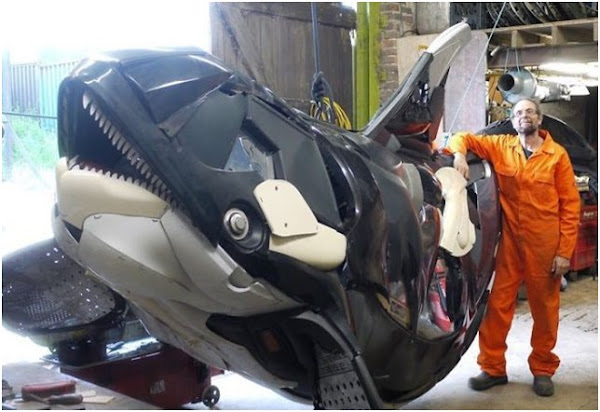
I first met Ptolemy way back in 2005 when I was researching a piece I was writing about luck. While thinking about the whole ‘lucky horseshoes’ business, I was struck by the fact that you rarely see horseshoes by the side of the road these days. Traditionally, for a horseshoe to be lucky, it should be ‘thrown’ by a horse. In the 21st century horses are more of a luxury item than a necessity and most are re-shod regularly, which means that the shoes don’t get worn enough to be thrown. I reckoned that, as cars have replaced the horse, maybe the modern equivalent is the plastic hubcap. Cars throw them all the time.
And, for Ptol, hubcaps have been very lucky indeed. They’ve given him a career as a professional artist.
‘There was a big bend in the road near where I was living with a few hubcaps lying around in the grass,’ he told me. ‘They were lovely and shiny and I liked the designs on them so I took them home, wanting to do something with them but not really knowing what. I had the idea of making a suit of armour out of them, but I never got round to it. So I forgot all about it for a while.’ But then, while travelling around India for a year, he was inspired by the way that people constantly re-use and recycle materials; not for art but as a necessity born out of poverty. Returning to the UK, and struck by just how wasteful we are by comparison, he became a fervent recycler, fixing broken items for resale and making art from the things that we shamefully throw away.
His hubcap creatures were an immediate hit ... although they were not without some teething troubles. ‘One of the repercussions of using hubcaps as your primary resource is that the size of the finished sculpt is set before you begin’, he explains. ‘You’d think people would realise that the sculptures are all going to be, at minimum, hubcap-sized. The fact that they’re buying from a company called Hubcap Creatures Ltd should also be a bit of a giveaway. But even then I’ve had one or two people say to me … ‘Well, it’s lovely and all that, but why is there a BMW logo in the middle of its body?’ And where do they think I’ll find hubcaps small enough to make a life-sized dragonfly? I’ve had to put the sizes on the website now.’


I've visited Ptolemy’s workshop in Brighton several times and it's always a joy. It's always full of fish, fowl and other animals all made from hubcaps cleverly folded, snipped, bolted and wired together. Fish work particularly well as the silver-coated plastic suggests the sheen of skin and scales beautifully. However, there are also wild boars, eagle owls, frilled lizards, wolves, octopuses, dragons and even saxophones. And all made from discarded hubcaps. To buy new ones would defeat the object and, anyway, he believes that scuff marks and other damage just adds to their charm: ‘The scars of their previous lives add texture and history to the creatures they decorate’, he says. ‘Just look at the skins of whales and dolphins; they show us the animal’s lifetime of experience. Just look at ourselves. We all have those marks and scars too.’
In recent years he’s swapped between hubcaps and metal, and has, among other things, created a series of giant pieces for Anglian Water. His water voles, bitterns, newts, ospreys and dragonflies have all been made from shopping trolleys pulled from rivers and canals. It's brilliant thinking.
His studio is a living testament to his recycling passion. The ceiling lights are headlights taken from scrapyard Citroen 2CVs. Hanging over the kitchen area there’s an F15 Eagle fighter plane made entirely from pieces of old Dyson vacuum cleaners with a Sodastream cover cockpit. There’s another small plane nearby made from a garden strimmer and wheels taken from the tape rollers inside an old VHS player. Rather than go to Ikea to buy an angle poise lamp, Ptolemy made his own from windscreen wipers, fat magic marker cases, food cans, salvaged wire and bits taken from the insides of dead washing machines.
It’s so tempting to draw parallels here with the wacky inventions of W Heath Robinson or Rube Goldberg, but there’s maybe a better clue to Ptol’s inventiveness right in front of you on his workbench: a
Blue Peter badge. Like me, he is of the generation of kids who tuned in twice a week to learn how to make space rockets from squeezy bottles and sticky-backed plastic, Christmas decorations from old coat hangers, and Barbie houses from shoe boxes (
as I wrote about here). When I suggested this, he nodded knowingly but also revealed that he’s been on the programme a couple of times and that one of his sculptures is in the Blue Peter garden. There’s no mention of that on his website, which is typical of the man’s quiet and self-effacing personality.
The final question, naturally, is about that name …
‘Yeah, I know. Dad has a thing about the letter ‘P’ I think’, he explains. ‘I’ve got a sister called Pandora and a brother called Piers. And Dad’s a Peter. Personally, I’m thankful. Before he decided on the P theme, I was going to be called Tarquin.’
‘But why Ptolemy and Pandora?’ I asked. ‘Are your parents into the Classics?’
‘Actually, they are a bit’, he said.
‘Piers isn’t very Egyptian’, I said.
‘No’, said Ptolemy, ‘But his middle name is Rameses.’
I’m still unsure whether or not he was pulling my leg.
Ptol's website
Hubcap Creatures is
here.


 The 3rd February is the feast day of St Blaise, the patron saint of Woolcombers. The saint was also venerated for his aid to sufferers of throat-related illnesses and some churches still offer throat blessings on this day. The most celebrated example of the service is held in London at St Etheldreda’s church in Holborn; two candles are held in the form of a cross to the throat and a blessing is said as the supplicant kneels at the chancel step.


 The event was revived in the early twenty-first century and is going from strength to strength, organised by a host of local groups including the schools, church and Town Council. Lanterns illuminate the dark lanes of the town accompanied by traditional Cornish music and led by the Bishop of Truro together with a local Boy Bishop, before a special Blessing of the Throats service at St Blaise church. This involves the Bishop and Vicar, ably assisted by the Boy Bishop, holding crossed candles up to the throat of each person being blessed and repeating a special prayer. This is followed by Cornish wassailing songs around a tree in the park, hot apple juice or mulled cider and saffron buns.